8:00 a.m -6:00 p.m
-
-
-
RMZ Ecoworld, Bellandur, Outer Ring Road
8:00 a.m -6:00 p.m
RMZ Ecoworld, Bellandur, Outer Ring Road
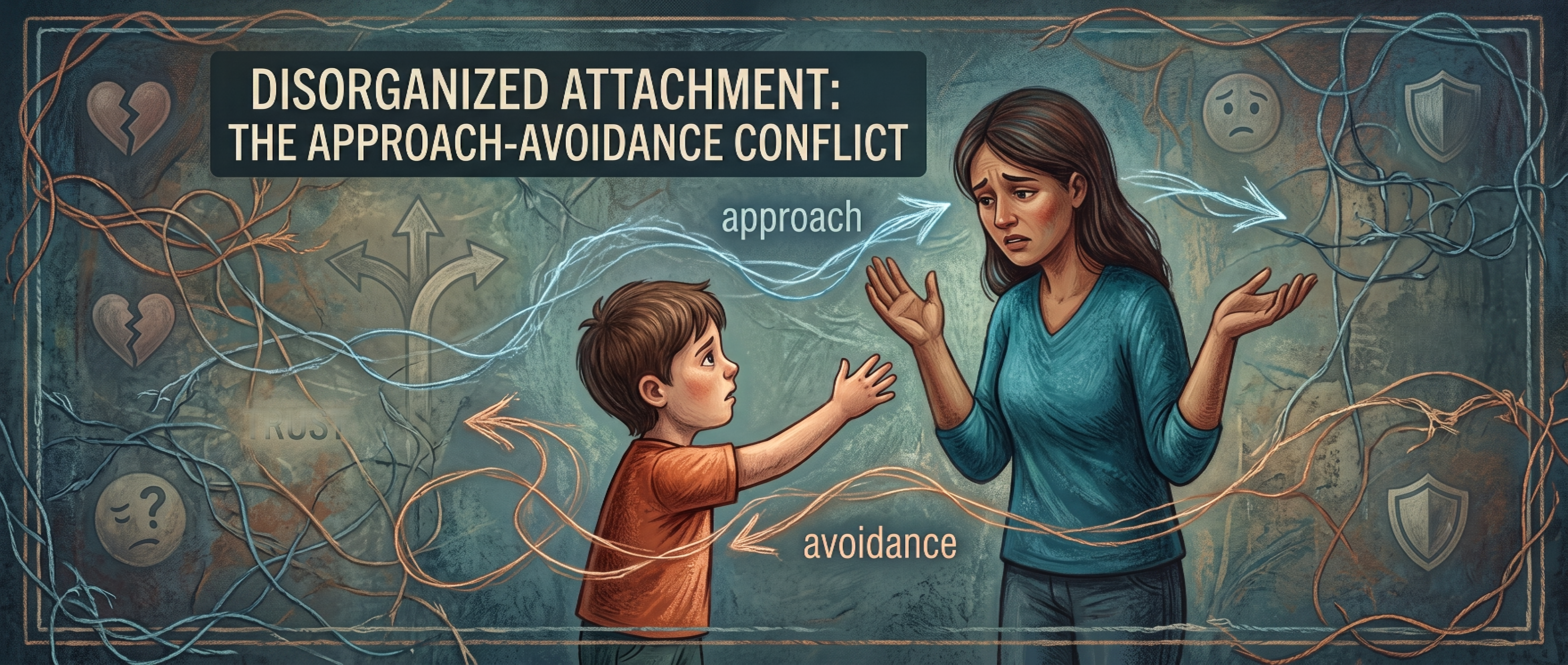
You want someone close. The moment they actually come close, something in you braces.
That contradiction is the most honest everyday description of what disorganised attachment feels like from the inside. Not coldness, not neediness, but both, sometimes within the same hour. You send the message and then regret sending it. You finally get the reassurance you asked for and it lands as pressure. Afterwards you decide there is something fundamentally wrong with you.
There isn't. What you are describing is a pattern with a name, a research history going back four decades, and a genuinely good evidence base for change.
This guide covers what disorganised attachment actually means (including what it does not mean), how it shows up in adult women, what causes it, why Indian family structures complicate the picture, and what real recovery involves.
Disorganised attachment is an insecure attachment pattern in which the person you depend on for safety is also the person who frightens you. Because there is no way to both approach and escape the same person, the usual strategies break down, and behaviour towards closeness becomes contradictory rather than consistent.
Attachment researchers call this the "fear without solution" problem, and it is the defining feature. Anxious attachment has a strategy: come closer, hold on, protest the distance. Avoidant attachment also has a strategy: need less, self-manage, keep the exit visible. Both are organised. Disorganisation is what happens when neither strategy is available, because the source of comfort and the source of alarm are the same person.
The classification came out of Mary Main and Judith Solomon's work in the late 1980s, reviewing infant behaviour in the Strange Situation that did not fit the three existing categories. Those infants did things that made no sense as a strategy: freezing halfway to the parent, approaching with the head turned away, starting a movement and abandoning it.
In adults, the same underlying conflict usually presents as what Bartholomew and Horowitz called fearful-avoidant attachment: wanting intimacy and fearing it at the same rate. Most people searching for their own attachment style will meet the terms "disorganised" and "fearful-avoidant" used interchangeably. They are close enough to be useful, but not identical, and the difference matters more than most articles admit.
(You will also see this spelled "disorganized attachment." Same pattern, American spelling.)
The row that surprises people is the last one. The behaviour is not random. It alternates because both drives are switched on and neither can win for long.
This is where most articles get sloppy, so it is worth being precise.
The largest meta-analysis, covering nearly 80 studies and more than 6,000 infant-parent pairs, found that roughly 15% of infants in ordinary, low-risk, middle-class samples were classified as disorganised. In clinical groups and higher-risk social contexts, that figure doubled or tripled. In maltreatment samples, reported rates have run as high as 77 to 85% (van IJzendoorn, Schuengel & Bakermans-Kranenburg, 1999).
Two honest caveats about that 15%.
First, it describes infant behaviour observed in a laboratory procedure, not adults filling in a questionnaire. When a website tells you "15 to 20% of adults have a disorganised attachment style," it is borrowing an infant statistic and quietly changing what it refers to.
Second, the adult picture uses a different instrument. In a separate meta-analysis of over 2,000 Adult Attachment Interviews, about 19% of non-clinical mothers were classified as unresolved with respect to loss or trauma, which is the adult category most closely related to disorganisation (van IJzendoorn & Bakermans-Kranenburg, 1996).
The practical takeaway: this is common, it is not rare or exotic, and no honest source can give you a clean percentage for "adults with disorganised attachment."
Recognition usually happens through pattern, not through any single item. Very few people tick everything here.
That third group is the one people miss. Disorganised attachment is not only a way of thinking about relationships. It runs through the nervous system, which is why insight alone tends to plateau and why our work at Manushee starts from the body as much as the story. If that pattern of activation and shutdown is familiar, our guide to regulating your nervous system covers the physiology in more depth.
The classic route is a caregiver who was frightening, or who was visibly frightened themselves, in the moments a child needed comfort. Main and Hesse's work pointed at both: a parent who alarms the child, and a parent who is alarmed in front of the child.
It is not always abuse. Common contributors include:
One finding that changes how people feel about their own history: a parent's unresolved loss or trauma predicts infant disorganisation even when their observable behaviour looks reasonably normal. The measured associations are moderate, not overwhelming, and researchers have never fully closed the gap between what a parent carries and what the child develops. Something is transmitted that we still cannot completely account for by observing behaviour.
Which means this. Your mother may have loved you, tried hard, and still passed on something she was never given the chance to process. Both things are true. Most women we work with need to hear that before they can look at any of this properly. If that lands, our work on intergenerational trauma is written for exactly this.
Adult experiences matter too. Attachment patterns are not sealed at age three. Abusive relationships, betrayal, sustained emotional invalidation and traumatic loss in adulthood can all deepen an existing pattern or produce one.
Almost every article you will read on this topic is written from a Western nuclear-family template. That template does not map cleanly onto most Indian childhoods, and the mismatch causes real confusion.
Attachment research in India is genuinely thin. A systematic review of Indian attachment studies noted the shortage directly, and major international meta-analyses have included little or no South Asian data (International Journal of Indian Psychology, 2021). So we are applying a framework built largely elsewhere, and it needs local translation.
In a joint family, a child may have five or six adults available. That can buffer beautifully. It can also mean that safety varies by which adult is in the room, and no one adult is reliably the safe one. A grandmother's lap and an uncle's temper in the same house teaches a child that closeness is a gamble.
Where family standing governs decisions, a child's distress can become a problem to be managed rather than a signal to be answered. Research on Indian families has traced how fear of shame ruptures parent-child relationships, and how avoiding repair leaves distance, mistrust and secrecy in place. Children raised inside that logic often learn that their inner life is dangerous to reveal.
Corporal punishment, public humiliation of children and shouting are still widely treated as ordinary parenting rather than as anything remarkable. A woman can therefore describe a genuinely frightening childhood in an entirely flat voice, and conclude she has nothing to complain about because "everyone was raised like that."
Partition, caste-based violence, displacement and generations of economic precarity did not stay with the people who lived through them. They shaped parenting styles, silences and what families decided could never be spoken about.
None of this makes Indian families uniquely damaging. It means that the standard checklist can return a false negative. If you have read about disorganised attachment and thought "but my parents weren't like that," these four patterns are worth sitting with.
We work only with women, and there are recurring places this pattern surfaces.
Moving into a household where you must build intimacy with people you did not choose is demanding for anyone. For a woman whose system already codes closeness as risk, it can trigger months of unexplained physical symptoms and emotional flattening.
Becoming a mother reactivates your own attachment history, often without warning. Women who were coping well can find themselves flooded, terrified of harming the baby, or unable to feel the connection they expected. This is common, treatable and not evidence of being a bad mother. Our work on fertility, pregnancy and postpartum is built around this.
Many women with this pattern function extremely well at work, where the rules are clear and closeness is optional. The cost arrives at home, in the relationships where performance is not enough.
Chronic pain, gut symptoms, autoimmune flares, migraines, disrupted cycles and fatigue that sleep does not touch appear repeatedly alongside attachment trauma. This is one reason our Integrated Nervous System Profile assesses physical health alongside relational history, rather than treating them as separate departments.
This matters, and it is where a lot of internet content does harm.
Disorganised attachment is a research classification describing a relationship, not a psychiatric diagnosis and not a personality type. It does not appear in the DSM or ICD. There is no blood test, no scan, and no fifteen-question quiz that can establish it.
Researchers themselves have raised concerns about how the concept travelled from the lab into popular use. A detailed study of how the classification has been interpreted found that understandings of disorganised attachment have been pulled towards one simplified image, a child afraid of its own parent, in ways the original coding never intended (Duschinsky & Solomon, 2017).
Several other things can look very similar and need different treatment:
A good assessment rules these in or out. Self-diagnosis from a blog, including this one, cannot.
Yes, and this is one of the better-supported findings in developmental psychology.
The relevant idea is earned security: adults with clearly adverse childhoods who nonetheless develop a coherent, integrated way of holding their own history and relating to others. It emerged from Adult Attachment Interview research, where a subgroup of people described genuinely difficult childhoods with the reflective coherence that characterises security. A 23-year longitudinal study later tested and supported the premise that these adults really had come from insecure or harsh beginnings (Roisman et al., 2002).
Two things worth holding together.
Earned-secure adults parent about as effectively as those who were securely attached all along. That is the hopeful part, and it is well replicated.
They also show somewhat higher rates of depressive symptoms than continuously secure adults. Healing changes what you do. It does not delete what happened. Anyone promising that it does is overselling.
What actually produces the change is not insight on its own. It is repeated experience of a relationship that stays steady when your pattern expects it to break, which is why therapy works partly through the therapeutic relationship itself and not only through technique.
Approaches with real support behind them for attachment trauma:
These are the four pillars our clinical work is built on, and you can read how we combine them in our approach.
What tends not to work on its own: attachment style quizzes, reading more about it, breaking up with anyone who triggers you, and waiting to feel ready. Understanding the pattern is the beginning of the work rather than the work itself.
Small and repeatable beats ambitious and abandoned.
Consider working with someone trained in trauma and attachment if you notice:
At Manushee, work usually begins with an Integrated Nervous System Profile, a whole-person assessment covering relational history, stress load, current relationships and physical health, so that support addresses what is actually driving the pattern.
From there, care draws on our four essential pillars: Somatic Experiencing, Internal Family Systems, attachment-focused therapy and functional medicine. Depending on what you need, that might include work on attachment and relational concerns, trauma and CPTSD, intergenerational trauma, couple's therapy, or EMDR.
You can meet our specialists and book a free discovery call whenever you feel ready.
If you are in acute distress right now, please reach out to a crisis line rather than waiting for an appointment. Manushee is not a crisis service, and the numbers are listed on our contact page