8:00 a.m -6:00 p.m
-
-
-
RMZ Ecoworld, Bellandur, Outer Ring Road
8:00 a.m -6:00 p.m
RMZ Ecoworld, Bellandur, Outer Ring Road
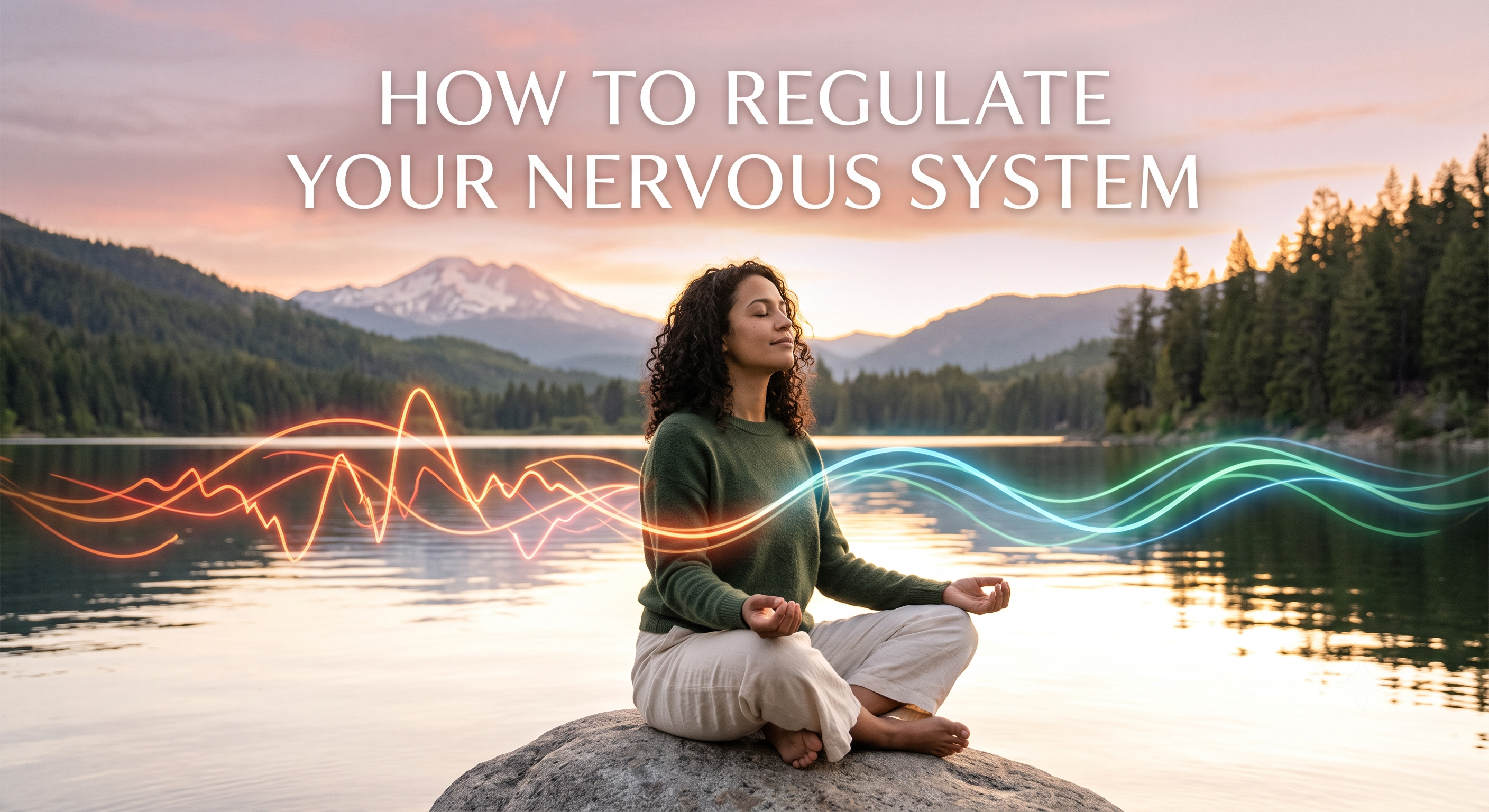
If you are wired at 11 p.m. and exhausted at 11 a.m., you are not short on willpower. You are living with a nervous system that has learned to stay on guard.
Learning how to regulate your nervous system is not about forcing yourself to be calm. It is about helping your body move flexibly between alertness and recovery, so activation rises when you need it and settles once the moment has passed. That flexibility is a skill your body can relearn — and it does not require an ice bath, a supplement stack or a month off work.
This guide covers what nervous system regulation actually means, how to spot dysregulation in both directions, eight practices with real evidence behind them, and the point at which self-help is no longer the right tool.
To regulate your nervous system means to help your body shift smoothly between activation and rest, instead of getting stuck in either state.
The work is done by your autonomic nervous system, which runs in the background without your input, managing heart rate, breathing, digestion and blood pressure. It has two branches that are meant to take turns.
The sympathetic nervous system drives the fight or flight response. When your brain registers a threat, it releases adrenaline and cortisol, your heart rate climbs, your breathing quickens and blood moves towards your large muscles so you can act.
The parasympathetic nervous system does the opposite. Often called "rest and digest," it slows the heart, restores digestion and allows repair. The vagus nerve — its longest branch — is the main line of communication between your brain and body.
Here is the part most wellness content gets wrong: nothing is inherently "bad for your nervous system." Your nervous system is a responsive system, not a fragile one. Stress responses are how a healthy body meets a demand. Research on trauma even suggests the opposite risk — people whose bodies under-react to stress can face poorer mental health outcomes, not better ones.
Dysregulation is not the presence of a stress response. It is the loss of the return journey — the alarm rings, and then it will not switch off.
Therapists often describe this using the window of tolerance: the zone where you can feel things, think clearly and stay connected at the same time. Regulation widens that window. It does not mean feeling calm all the time.
Dysregulation runs in two directions. Most articles only describe the first, which is why so many women read them and think this isn't me.
| Too activated (hyperarousal) | Shut down (hypoarousal) | |
|---|---|---|
| Body | Racing heart, tight chest or jaw, shallow breathing, gut trouble, disrupted sleep. | Heaviness, numbness, cold hands, deep fatigue that rest doesn't fix. |
| Mind | Thoughts on a loop, scanning for problems, unable to switch off. | Foggy, blank, detached, decisions feel impossible. |
| Behaviour | Overworking, snapping, over-explaining, unable to sit still. | Endless scrolling, cancelling plans, withdrawing from people. |
| What helps | Slowing down: longer exhales, softening, less input. | Gently coming up: movement, light, sound, company. |
Swinging between the two in a single day is extremely common — buzzing through the morning, flattening by evening. That pattern is not a personality flaw. It is a system that has lost its brakes and its accelerator at the same time.
Three forces show up again and again in our clinical work.
Cumulative load. Caregiving, household management, emotional labour and paid work rarely stop at the same time. When there is no true off-switch in a day, the body never gets the signal that the demand has passed.
Hormonal transitions. Oestrogen and progesterone interact with the brain's stress circuitry. Many women notice their tolerance for noise, conflict and uncertainty shifts across the menstrual cycle, and shifts again during pregnancy, the postpartum year and perimenopause. The stress is not new. The buffer has thinned.
Unprocessed experience. Trauma and adverse life events physically change how readily the alarm fires. This is why someone can be objectively safe and still feel hunted. It is an injury, not a weakness — and injuries heal with the right care.
One practical note: thyroid conditions, anaemia, chronic pain, perimenopausal changes and some medications can all mimic dysregulation. If your symptoms are persistent, get the physical causes checked before assuming the problem is purely psychological.
The first three shift your state within minutes. The last five change your baseline over weeks.
Your heart rate rises slightly on the inhale and falls on the exhale. Making the out-breath longer than the in-breath tilts you towards the parasympathetic nervous system.
The simplest version is the physiological sigh: two short inhales through the nose, then one long, slow exhale through the mouth. Repeat for a few minutes. Or breathe in for a count of four and out for a count of six to eight.
In a 2023 randomised trial at Stanford, published in Cell Reports Medicine, five minutes a day of this "cyclic sighing" pattern improved mood and reduced breathing rate more than mindfulness meditation over one month (read the study).
Worth knowing honestly: that same trial found no significant change in resting heart rate or heart rate variability. Breathing changes how you feel faster than it changes what a wearable measures.
When you are activated, your attention narrows onto the threat. Orienting reverses that.
Slowly turn your head. Let your eyes land on three things and quietly name them. Notice the temperature, the light, the sound furthest away. Feel your feet against the floor.
You are giving your brain current evidence that the room is safe, rather than arguing with the fear. The familiar 5-4-3-2-1 exercise works on the same principle.
The fight or flight response prepares your muscles for action. When the action never comes — because you stayed polite in the meeting — that charge lingers in the body.
Ten minutes of brisk walking, a flight of stairs, shaking out your hands and arms, or dancing to one song will discharge more than an hour of trying to think your way calm. Gentle and regular beats intense and occasional.
The vagus nerve supplies the muscles of the throat and voice box, which is one reason humming, chanting, singing and even slow gargling can feel steadying. Humming also lengthens your exhale automatically, so you get two effects at once.
Human nervous systems regulate each other. Sitting beside a calm person, a ten-minute phone call, a hand on your back — co-regulation is often faster than any solo technique.
For many women the missing piece is not a better breathing app. It is one relationship where they do not have to perform being fine.
A blood sugar dip is read by the brain as a threat. Skipping meals, then running on caffeine, reliably manufactures anxiety. Aim for regular meals that include protein, and drink water before you reach for a third coffee.
Sleep matters just as much. A consistent wake time, morning daylight and screens down before bed do more for your baseline than any single relaxation exercise.
Notifications, background noise, group chats and constant task-switching keep the system mildly braced all day. Ten genuinely quiet minutes — no podcast, no scrolling — is a nervous system intervention, even though it feels like doing nothing.
This is the step most people skip. A technique you have only ever tried mid-panic will not be available mid-panic. Five minutes on an ordinary Tuesday builds the pathway you will need on a hard Thursday.
| If you feel... | Your system is... | Try first |
|---|---|---|
| Racing, tense, irritable | Over-activated | Extended exhale, then a brisk walk. |
| Flat, numb, foggy | Shut down | Gentle movement, daylight, music, call someone. |
| Up and down all day | Losing its rhythm | Fixed wake time and regular meals for two weeks. |
| A sudden surge of panic | Alarm firing | Feet on the floor, orient to the room, long exhales. |
| Fine until bedtime | Unloading late | A wind-down hour and quiet input from early evening. |
A single state shift can happen in two to five minutes. A noticeably different baseline usually takes four to eight weeks of near-daily practice.
Where chronic stress or trauma is involved, the timeline is longer and rarely linear — better weeks, harder weeks, gradual widening of the window. Anyone promising a permanent reset in days is selling something.
Breathing exercises, grounding and cold water trends are, at their core, distress tolerance tools. They help you get through a moment. They are genuinely useful, and they are not treatment.
Used alone, they plateau. Their real value is that they settle you enough to do the work that actually changes things: understanding your patterns, processing what happened, setting boundaries, grieving, repairing relationships, or treating an underlying condition.
If you have been diligently breathing for six months and nothing has moved, that is not a sign you are doing it wrong. It is a sign the tool is too small for the job.
Consider working with a trained professional if you notice any of the following:
At Manushee, our work begins with an Integrated Nervous System Profile — a whole-person assessment of history, stress load, relationships and physical health, so support is built on what is actually driving your symptoms.
From there, care draws on our four essential pillars: Somatic Experiencing, Internal Family Systems, attachment-focused therapy and functional medicine. Depending on your needs, that may include EMDR, Brainspotting, vagus nerve stimulation, or structured support for chronic stress, anxiety-related disorders, trauma and CPTSD or sleep difficulties.
You can meet our specialists and book a free discovery call whenever you feel ready.