8:00 a.m -6:00 p.m
-
-
-
RMZ Ecoworld, Bellandur, Outer Ring Road
8:00 a.m -6:00 p.m
RMZ Ecoworld, Bellandur, Outer Ring Road
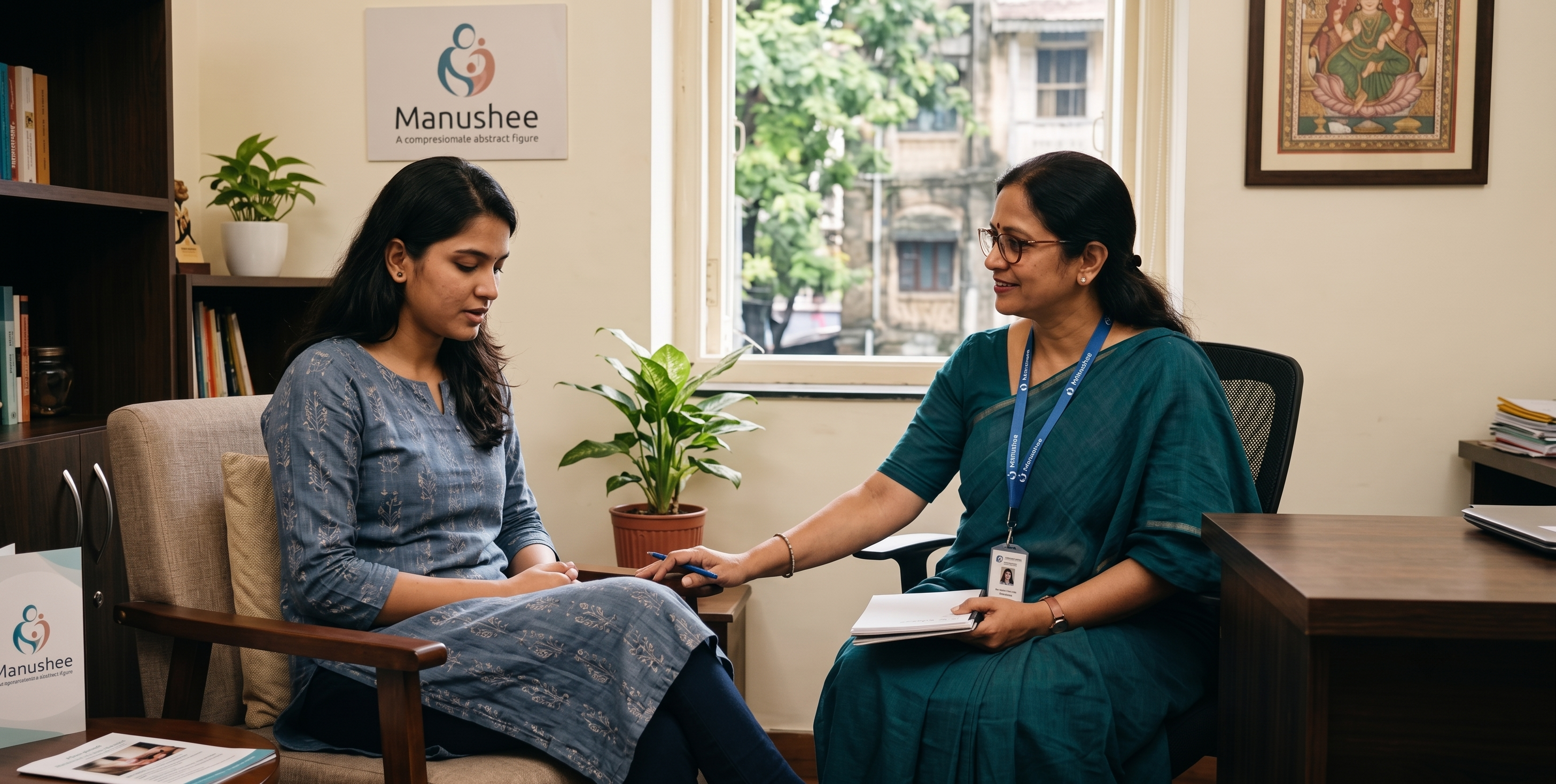
Dr. Sunanda Kolhe, PhD (Clinical Psychology) | Trauma and Attachment Informed Therapist
Women live with post-traumatic stress symptoms for around four years before they are diagnosed and treated. For men the average is one year. Some of that gap is stigma, and some of it is that trauma in women gets filed under anxiety, low mood or "stress" for years before anyone asks what happened to her.
But a large part of it is simpler. Most people have no idea what PTSD specialists actually do, or how to tell a genuine one from a therapist who lists trauma among fifteen other interests on a directory profile.
This guide covers what a PTSD specialist is, which treatments they should be trained in, how to verify credentials in India, and the questions worth asking before you pay for a first session.
A PTSD specialist is a mental health professional with formal, supervised training in at least one trauma-focused treatment that has been tested for post-traumatic stress disorder. They assess trauma symptoms using structured clinical tools and treat those symptoms as the main problem, rather than as background detail behind a diagnosis of anxiety or depression.
The training is the part that matters. "Specialist" is not a protected title in India, the UK, the US or almost anywhere else. Anyone can write it on a profile. What cannot be invented is a certification in a named protocol, the supervision hours behind it, and the ability to explain how that protocol works when you ask.
Three kinds of professional commonly work as PTSD specialists:
If you are unsure which of these you need, our guide on choosing between a psychologist and a psychiatrist walks through the difference.
This confusion costs people months. "Trauma-informed" describes a way of working. It is a stance every clinician should hold. Specialist training is a specific, examinable skill set on top of that stance.
| Trauma-informed therapist | PTSD specialist | |
|---|---|---|
| What it means | Works in a way that prioritises safety, choice and pacing, and avoids re-traumatising you | Trained to deliver a named treatment protocol tested on PTSD |
| Training required | A workshop, a module, or an organisational policy | Certification, supervised cases, ongoing consultation |
| Assessment | Usually a clinical conversation | Structured measures such as the PCL-5, CAPS-5 or the International Trauma Questionnaire |
| Handles trauma memories | Often avoids them, or works around them | Works directly with them, at a pace you set |
| You should expect | This from everyone you see | This when PTSD is the reason you are seeking help |
A good PTSD specialist is both. A trauma-informed therapist without protocol training is not a substitute, and plenty of caring, competent therapists fall into that second group without saying so.
The World Health Organization's ICD-11 established complex PTSD as a diagnosis in its own right, separate from PTSD. It includes everything PTSD does, plus three further clusters that clinicians group under "disturbances in self-organisation":
That distinction is not academic. Single-incident PTSD after an accident or an assault often responds well to a focused course of treatment. Complex PTSD, which typically follows prolonged or repeated harm in childhood or inside a relationship you could not leave, usually needs longer stabilisation before memory processing begins, and far more attention to attachment.
Some PTSD specialists are excellent with single-incident trauma and out of their depth with the complex presentation. Ask directly. A clinician who works with trauma and CPTSD regularly will answer without hesitating.
Two of the most rigorous guideline bodies in the field reach nearly the same conclusion. The UK's National Institute for Health and Care Excellence recommends individual trauma-focused CBT or EMDR for adults, and says medication should not be the routine first choice ahead of psychological therapy. The American Psychological Association strongly recommends four cognitive behavioural variants, and gives EMDR a conditional recommendation.
| Treatment | What happens in it | Guideline status |
|---|---|---|
| Cognitive Processing Therapy (CPT) | You examine and revise the beliefs the trauma installed, often in writing | Strongly recommended by the APA |
| Prolonged Exposure (PE) | You revisit the memory in a controlled way, and gradually re-approach avoided situations | Strongly recommended by the APA |
| Trauma-focused CBT | Combines memory work with restructuring, over a structured course | Recommended by NICE and the APA |
| EMDR | You hold the memory in mind alongside bilateral stimulation such as guided eye movement | Recommended by NICE, conditionally by the APA |
| Somatic and parts-based work, including Somatic Experiencing and IFS | Works through body sensation and internal conflict rather than narrative first | Promising early evidence, much smaller than the above |
That last row deserves honesty, because our own practice leans on it. Somatic and parts-based approaches are genuinely useful, particularly for people who dissociate, freeze, or cannot yet tolerate talking about what happened. But the trial evidence behind them is thinner and newer than the evidence behind CPT, PE and EMDR. Treat any clinician who tells you otherwise with caution.
In practice, most experienced PTSD specialists blend. They might use somatic stabilisation for the first several sessions, then move into a structured protocol once your system can hold it. What you want to avoid is a practitioner who offers only the gentle, open-ended part and never gets to the processing.
Women who experience trauma develop PTSD at two to three times the rate men do. Lifetime prevalence sits at roughly 10 to 12 percent for women, against 5 to 6 percent for men. The gap holds even when the type of trauma is the same.
Part of the explanation is exposure. Women face more interpersonal trauma, including sexual violence, and often face it younger. Part of it is what happens afterwards: interpersonal trauma is harder to disclose, more likely to be disbelieved, and more likely to involve someone still present in your life.
Then there is the reproductive dimension, which is where general PTSD services in India tend to be weakest. Pregnancy loss, traumatic birth, infertility treatment, invasive gynaecological procedures and hormonal transitions all interact with trauma symptoms. Many women notice their symptoms sharpen premenstrually, in the postpartum year, or during perimenopause, and are told that is unrelated. It usually is not.
Misdiagnosis follows. Hypervigilance is read as generalised anxiety. Emotional flooding is read as bipolar disorder or a personality disorder. Numbness and exhaustion are read as depression. Each of those diagnoses attracts a different treatment, and none of them touches the trauma underneath. That is the four-year delay, and it is the strongest single argument for looking specifically for PTSD specialists rather than for a therapist in general.
This is where most international advice stops being useful, because the regulatory structure here is different.
Clinical psychology in India is regulated by the Rehabilitation Council of India, which maintains the Central Rehabilitation Register. Anyone practising as a clinical psychologist should hold a CRR number, and you can check it yourself in about a minute on the RCI public register by searching either their name or their CRR number. Psychiatrists are medical doctors and are registered with the National Medical Commission or their state medical council.
The titles "counsellor", "psychotherapist", "trauma coach" and "healer" carry no such requirement. Some of the people using them are very well trained. Others completed a weekend certification. There is currently no register that lets you tell the difference at a glance, so you have to ask.
For protocol training specifically, ask which body certified them and when. EMDR training, for instance, runs through accredited programmes with named levels and supervised consultation hours. A trained clinician will tell you their level without being defensive about it.
None of this is bureaucratic box-ticking. Between 70 and 92 percent of people with mental illness in India receive no treatment at all, and the shortage of qualified professionals is one reason the gap has stayed that wide. It has also left room for a lot of unregulated practice. Checking a register is the cheapest protection available to you.
Most clinics offer a short introductory call. Use it. Genuine PTSD specialists will not be irritated by any of these.
| Ask this | What a strong answer sounds like |
|---|---|
| What trauma-focused training have you completed, and who certified it? | A named protocol, a named training body, a rough date |
| How do you assess PTSD? | Names a structured measure rather than only a conversation |
| Do you work with complex PTSD as well as single-incident trauma? | A clear yes or a clear no, with a referral if no |
| How do you decide when someone is ready to process memories? | Describes stabilisation and specific readiness signals |
| Roughly how many sessions, and how will we know it is working? | Gives a range, names how progress gets measured |
| What happens if I get worse before I get better? | Has a plan, and says so calmly |
| Do you have experience with reproductive or perinatal trauma? | Relevant if this is part of your history |
Vagueness on the first two questions is the signal to keep looking. Everything else can be negotiated.
That last one is worth naming plainly. A specialist who conveys impatience with your pace is not a good fit, regardless of their qualifications.
Expect assessment first. A specialist should take a full history, screen for other conditions, ask about physical health, medication, sleep and substance use, and use at least one validated measure so there is a baseline to compare against later.
Then stabilisation. Before you go near the memory, you need reliable ways to come back from activation. For some people that takes two sessions. For others, particularly with complex PTSD, it takes months, and that is not a delay in treatment. It is treatment.
Processing comes after. NICE suggests a typical course of trauma-focused CBT runs 8 to 12 sessions, with more where clinically indicated, such as after multiple traumas. Complex presentations routinely run longer. Anyone giving you a firm number before they have assessed you is guessing.
Symptoms often dip before they lift. Good PTSD specialists tell you this in advance rather than letting you discover it alone in week five.
Manushee is a women's-only practice. Every woman who comes to us starts with an Integrated Nervous System Profile, a whole-person assessment covering trauma history, current stress load, relationships, hormonal health and physical symptoms, so that treatment is built on what is actually driving things rather than on a first impression.
Care then draws on our four essential pillars: Somatic Experiencing, Internal Family Systems, attachment-focused therapy and functional medicine. Depending on what the assessment shows, that may include EMDR or Brainspotting, alongside structured support for trauma and CPTSD, intergenerational trauma, anxiety-related disorders or chronic stress.
If you are not ready to book anything yet, our guide to regulating your nervous system is a reasonable place to start on your own.
When you are ready, you can meet our specialists and book a free discovery call.
Manushee is not a crisis service. If you are in immediate danger or thinking about ending your life, please contact a crisis helpline. The numbers are listed on our contact page.