8:00 a.m -6:00 p.m
-
-
-
RMZ Ecoworld, Bellandur, Outer Ring Road
8:00 a.m -6:00 p.m
RMZ Ecoworld, Bellandur, Outer Ring Road
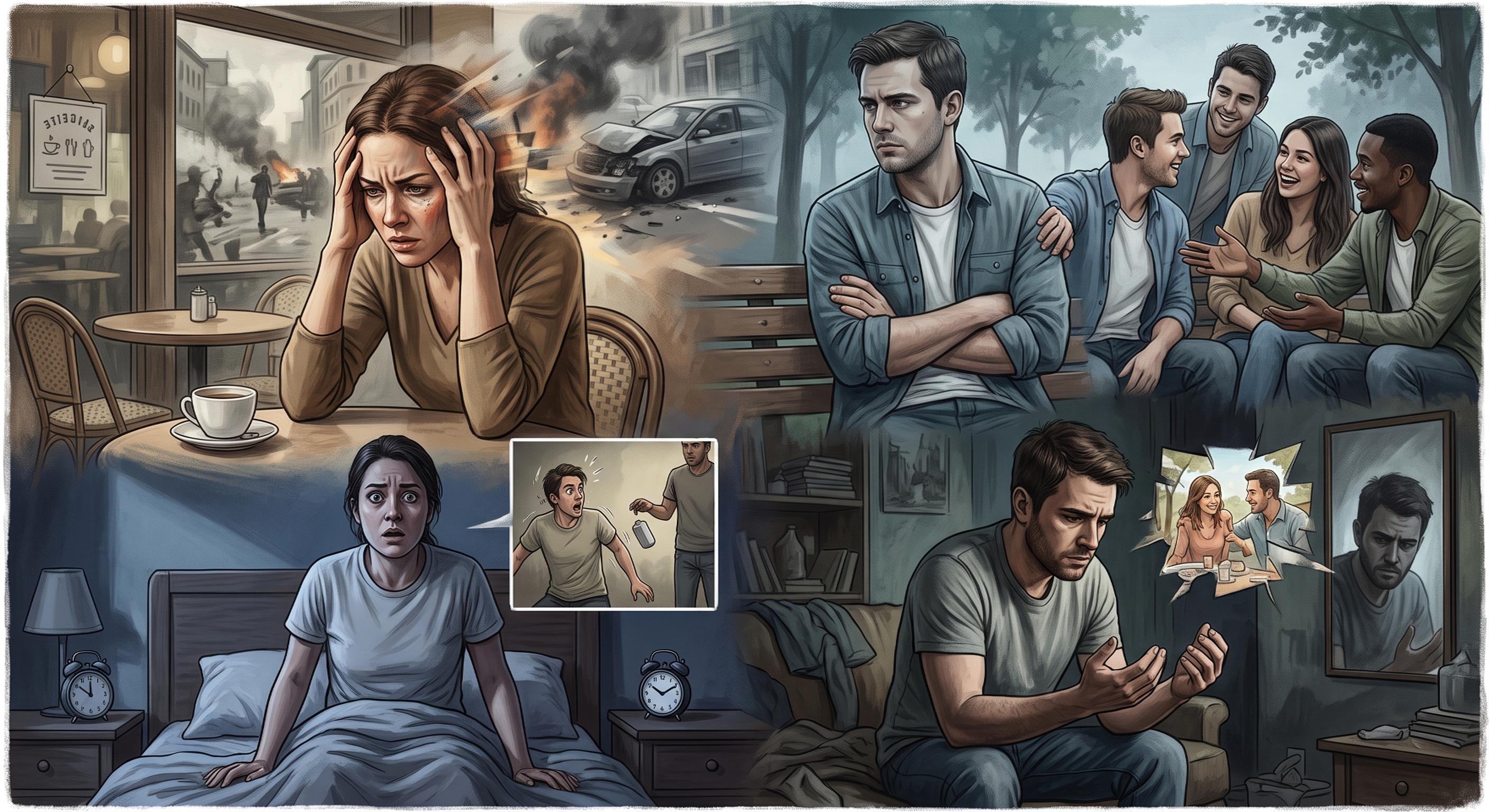
If you've searched for "what are the 17 symptoms of PTSD," you're probably trying to understand something happening to you or to someone you love. Post-traumatic stress disorder (PTSD) rarely looks like what films show us. It can show up as a racing heart in a quiet room, a short temper that seems to come from nowhere, or a quiet pulling-away from people who care. This guide breaks down what PTSD actually is, how it's diagnosed, and the 17 most commonly described signs and symptoms of PTSD — so you can recognize what you're seeing and know what to do next.
PTSD is a mental health condition that can develop after someone experiences or witnesses a life-threatening, violent, or deeply frightening event. Common examples include a serious accident, physical or sexual assault, combat, a natural disaster, an abusive relationship, or the sudden loss of someone close.
In the moment, the body's fight-or-flight response takes over. Heart rate climbs, senses sharpen, and stress hormones flood the system. This reaction involves the brain's fear-processing network, including the amygdala and prefrontal cortex, and it's meant to protect you.
In most people, this response settles once the danger has passed. With PTSD, it doesn't fully switch off. The nervous system keeps behaving as though the threat is still active, sometimes for months or years afterward.
Symptoms typically begin within three months of the event, though they can surface later. For a diagnosis, they need to last longer than a month and noticeably interfere with daily life, work, or relationships.
Some trauma isn't a single event but a prolonged pattern — years of childhood abuse, ongoing domestic violence, captivity, or repeated exposure to danger. This kind of experience can lead to Complex PTSD (C-PTSD).
C-PTSD is a diagnosis recognised in the World Health Organization's ICD-11, though it isn't listed as a separate diagnosis in the DSM-5 used across much of the US. People sometimes search for "the 17 symptoms of complex PTSD" expecting a similar numbered list. In practice, C-PTSD is better understood as the core symptoms of PTSD plus three additional difficulties, which clinicians group under "disturbances in self-organisation":
Because it grows out of repeated or inescapable trauma, C-PTSD often calls for a longer, more layered course of treatment than PTSD from a single incident.
A PTSD diagnosis is made by a mental health professional — a psychiatrist, clinical psychologist, or trauma-trained therapist. This usually happens through a detailed clinical interview, sometimes alongside a validated symptom checklist.
The diagnostic manual most clinicians currently use, the DSM-5-TR, groups PTSD symptoms into four categories:
Meeting the criteria means having at least one intrusion symptom, one avoidance symptom, two cognition and mood symptoms, and two arousal and reactivity symptoms. These must last more than a month, cause real distress or impairment in daily life, and not be better explained by medication, substance use, or another condition.
An earlier version of this manual, the DSM-IV, organised similar symptoms into 17 specific criteria across three categories. This is where the popular "17 symptoms" framing many people search for actually comes from. Clinical guidelines have since moved to four broader categories, but the 17-symptom breakdown below remains a genuinely useful, practical way to recognise how PTSD tends to show up day to day.
PTSD symptoms don't appear in a fixed order, and very few people experience all of them at once. What follows is a practical breakdown of the 17 signs most commonly described across clinical literature and patient resources. You'll notice a pattern: memories that intrude uninvited, active avoidance of anything that recalls the traumatic event, shifts in mood and self-perception, and a body that stays braced for danger long after it's passed.
Intrusive thoughts are among the best-known symptoms of PTSD. They're sudden, unwelcome memories or images of the traumatic event that surface without warning, often in the middle of an ordinary moment. They can be set off by something related to the trauma, or seem to appear out of nowhere — and they're rarely something a person can simply choose to stop thinking about.
Trauma-related nightmares often replay the event itself or carry its emotional charge — fear, helplessness, horror — even when the imagery is different. Beyond disrupted sleep, they can leave someone dreading bedtime altogether, which only adds to daytime exhaustion.
Hypervigilance is a heightened, exhausting state of alertness. It might look like constantly scanning a room, sitting facing the door, or noticing every sound before anyone else does. It develops as a protective habit after trauma, but it makes it hard to ever fully relax, even somewhere safe.
Flashbacks go a step further than intrusive memories. During one, a person may feel as though the trauma is happening again right now — sometimes with the same sounds, smells, or physical sensations as the original event. They can be triggered by something subtle, like a tone of voice, and can feel disorienting or frightening while they last.
Emotional numbness shows up as feeling flat, distant, or cut off — from other people, from surroundings, or from one's own feelings. It's often the mind's way of protecting itself from being overwhelmed, but it can make it hard to feel joy, closeness, or connection, even in good moments.
An exaggerated startle response means small surprises trigger a big reaction. A dropped plate, a car backfiring, or someone walking up unexpectedly can cause a jump, a spike in heart rate, or a jolt of fear that feels out of proportion to what happened. It's a sign the nervous system's threat-detection is running on high alert.
Avoidance can mean steering clear of people, places, conversations, or situations that recall the trauma. Someone who survived a car accident might stop driving. Someone assaulted at a particular location might reroute their entire day to avoid it. Avoidance also includes pushing away thoughts or feelings related to the traumatic event itself — which, over time, can quietly shrink a person's world.
PTSD often brings a persistent low or negative mood. It also brings distorted, harsher beliefs about oneself, other people, or the world — negative thoughts like "I'm not safe anywhere" or "no one can be trusted." These aren't stubbornness or pessimism. They're a genuine symptom of how trauma reshapes thinking.
Many people with PTSD carry guilt or shame about the event itself, about how they responded in the moment, or simply about surviving when others didn't. This self-blame is rarely accurate, but it can be one of the heaviest symptoms to carry. It often keeps people from reaching out for support.
Trauma can make closeness feel risky. Some people withdraw from friends and family; others find themselves in frequent conflict, triggered by things loved ones don't fully understand. Both patterns are common, and neither reflects a lack of love — they reflect a nervous system trying to stay safe.
Anxiety frequently travels alongside PTSD. It can show up as persistent worry, a racing heart rate, shallow or rapid breathing, muscle tension, or a constant sense that something bad is about to happen. For many people, this anxiety is less about the present moment and more a body still bracing for the past to repeat itself.
A short fuse, sudden outbursts, or a background hum of irritability are common in PTSD. These are tied to a nervous system stuck in fight-or-flight mode. Anger can also be a more socially acceptable stand-in for emotions that feel harder to show, like fear or grief.
When part of the brain stays focused on scanning for danger, there's less bandwidth left for everyday focus. Following a conversation, finishing a task, or remembering where you put your keys can all feel harder than they should. Some people also notice gaps in memory around parts of the traumatic event itself — the mind's way of limiting exposure to something overwhelming.
Beyond nightmares, many people with PTSD struggle simply to fall or stay asleep. A nervous system that won't fully power down makes it hard to feel safe enough to rest. The resulting exhaustion tends to make every other symptom on this list harder to manage.
Activities that once felt enjoyable — hobbies, socialising, even small everyday pleasures — can start to feel flat or pointless. This isn't laziness. It's a genuine symptom, closely related to the emotional numbness and low mood that often accompany PTSD.
Alcohol or drugs are sometimes used to quiet intrusive memories or numb difficult emotions. The short-term relief can feel like the only thing that works. Over time, though, this coping strategy tends to deepen distress, and can develop into a substance use disorder of its own — which is why it's worth naming as a symptom of PTSD rather than a personal failing.
Reckless driving, unsafe choices, and other self-destructive patterns sometimes appear alongside PTSD. This tends to happen when someone feels overwhelmed and is searching for a way to feel something — or feel nothing at all. If risky behavior has started to feel like the only outlet, that's a strong signal to bring in a mental health professional rather than manage it alone.
A trigger is anything that brings the trauma back to mind and makes symptoms flare, even when someone was doing fine moments before. Common triggers include:
Triggers are a normal part of living with PTSD, not a sign that healing isn't happening.
Because triggers are often personal and sometimes surprising, it helps to notice patterns rather than assume they'll be obvious. Keeping a simple note of what was happening right before a symptom flared — the place, the sound, the conversation — can reveal connections over time. A trauma-informed therapist can help make sense of these patterns and build grounding techniques for the moments a trigger catches you off guard.
Recognising these symptoms in yourself or someone you love is already a meaningful first step. PTSD is treatable. Approaches like trauma-focused CBT, EMDR, and nervous-system-focused, trauma-informed therapy have strong evidence behind them, and most people who receive effective treatment for PTSD see real, lasting improvement.
In India, PTSD is significantly underdiagnosed. The National Mental Health Survey puts overall prevalence at just 0.2%, yet studies of specific high-risk groups — including survivors of domestic violence and natural disasters — report rates as high as 25–40%. Much of this gap comes down to stigma, limited awareness, and diagnostic tools that don't always reflect how trauma shows up locally. Research also shows PTSD affects women more than men in India, particularly in the context of ongoing domestic trauma — exactly why compassionate, trauma-informed, women-centred care matters so much.
If any of this feels familiar, know that you don't have to sort it out alone. If you're in India and need to talk to someone right now, KIRAN (1800-599-0019) and Tele MANAS (14416 or 1-800-891-4416) are free, 24/7, government-run helplines available in multiple languages. The Vandrevala Foundation Helpline (9999 666 555) offers 24/7 support as well. And when you're ready for a longer conversation, Manushee's trauma-informed therapists work specifically with women navigating chronic stress and trauma and can help you build a path forward that fits your story.