8:00 a.m -6:00 p.m
-
-
-
RMZ Ecoworld, Bellandur, Outer Ring Road
8:00 a.m -6:00 p.m
RMZ Ecoworld, Bellandur, Outer Ring Road
Posted on February 04, 2026 by Dr. Sunanda kolhe
You’re fine one moment, maybe sipping tea, scrolling through pictures, laughing with a friend and suddenly, something shifts inside you.
The sound of laughter changes pitch. The air feels heavier. Your chest tightens. A wave of fear or shame, or sudden panic washes through your body, unstoppable, familiar, and confusing. You know, logically, that you are safe. But your body doesn’t believe you.
This is what trauma often feels like not a memory, but a moment. A wave that rises without warning, demanding attention. And while it feels like madness, it’s not madness at all. It’s the body remembering what the mind worked hard to forget.
Trauma is not just about what happened. It is about what stayed.
It is the unprocessed surge of energy that didn’t get to complete its cycle ,the scream that wasn’t allowed, the flight that wasn’t possible, the defense that wasn’t safe.
When something terrifying, helpless, or shaming happens, the body shifts into a survival state powered by the autonomic nervous system: adrenaline spikes, breathing shortens, muscles contract. The amygdala, the brain’s alarm bell, takes over while the prefrontal cortex—the rational, planning part—temporarily shuts down.
This is biology saying: “Don’t think. Run. Hide. Freeze.”
But when escape or release isn’t possible ,as in situations of violence, neglect, or loss ,the hormones flood, and then freeze. The nervous system never fully returns to balance. It waits, years later, for the safety that was missing then. Every small cue ,a tone of voice, a smell, a word ,can pull that unreleased fear back to the surface.
That wave you feel? It’s the body finally trying to complete an unfinished story.
Fear is often the first response people expect in trauma. Shame, though, can be the one that destroys silence the most quietly. Shame says, “Something in me caused this.” It’s how the mind tries to create control when control was taken away. If you believe you’re to blame, it gives the illusion that you could have done something to prevent the pain. That illusion, painful as it is, can feel safer than pure helplessness. Yet shame isolates. It keeps the trauma locked inside. Studies on trauma and emotional memory show that shame activates the same network in the brain as physical pain. It literally hurts to feel unworthy. And because shame thrives on secrecy, it silences the very cry that could bring relief: “I need help.” Healing begins when that silence is broken.
The “wave” so many trauma survivors describe is more than metaphor ,it’s measurable. Body-oriented trauma research, from trauma theorists like Bessel van der Kolk and Peter Levine, shows that unprocessed trauma lingers in the body’s autonomic and limbic systems ,the ancient circuits that govern survival. When an external cue or internal thought even faintly resembles the original threat, the body reacts as if the event is happening again. Adrenaline surges. Muscles brace. The vagus nerve, which regulates emotional safety, constricts. In that moment, logic is useless. You tell yourself: “It’s over.” The body whispers back: “Not yet.” This mismatch between what you know and what you feel creates the flood of panic, disconnection, or shame. It’s not weakness or lack of self-control ,it’s a physiological flashback.
Unlike visual flashbacks ,where a person sees flashes of a traumatic event ,emotional flashbacks are often invisible. They feel like sudden drops into dread, despair, or worthlessness. No image, no timeline, only emotion. Psychotherapist Pete Walker calls this “the collapse” ,a state where an old emotional memory hijacks present-day consciousness. It might last minutes or hours. You might feel small, unloved, defective, or terrified without any clear reason. But the reason exists ,it’s just stored in another part of the brain. Your mind can’t reach it logically, but your body remembers it perfectly.
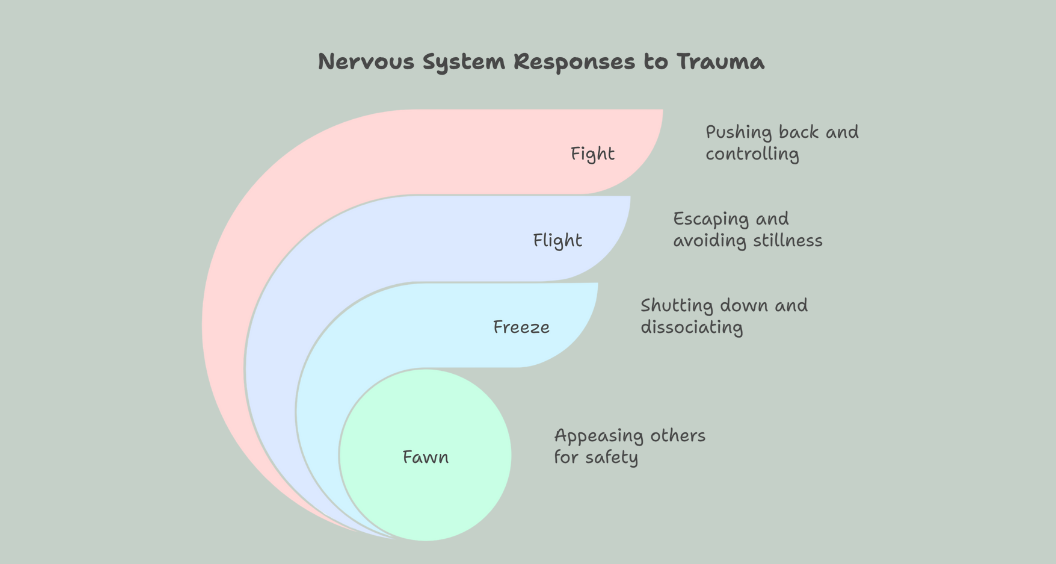
Trauma once was simplified into fight, flight, and freeze. Now, psychologists include a fourth: fawn. These are the instinctive roles people shift through when the nervous system senses threat.
These responses are not personality traits. They are survival codes.
If you grew up in chaos, you may have developed a “fawn-freeze” cycle ,alternating between compliance and collapse ,which shows up later as difficulty setting boundaries or trusting safety even in safe relationships.
These automatic responses are not broken systems; they’re overlearned protection. Healing means teaching the body there’s another way to survive ,without constant alarms.

Why do trauma responses persist long after danger ends?
The answer lies in how the brain processes memories. When experiences are overwhelming, the hippocampus, which creates chronological memory, shuts down. This means traumatic events don’t get filed as “past.” Instead, they float as fragments: sensations, smells, feelings ,alive and timeless.
So when you experience a trigger, your brain replays these fragments as if today is then.
Therapy helps “re-file” these memories ,to label them as events that happened rather than are happening. Only then can your nervous system update its story.
In The Body Keeps the Score, psychiatrist Bessel van der Kolk writes:
“The body remembers what the mind forgets.”
Muscle tension, chronic fatigue, migraines, gut issues, sleep problems ,these can all be disguised trauma symptoms.
Because the nervous system controls every organ, long-term activation leads to inflammation, hormonal imbalance, and disconnection from bodily cues.
Healing trauma, therefore, isn’t about “getting over it.”
It’s about reconnecting—teaching your body that the danger has passed and that it can once again feel safe in stillness, touch, and trust.
Healing from trauma isn’t a straight line. It’s a spiral ,slow, uneven, and deeply personal. But it always begins with one step: recognition.
You begin to name what is happening instead of acting it out or numbing it. “This feeling isn’t madness; it’s my body remembering.”
Naming the wave instantly gives the rational brain a thread to hold.
Healing is rarely dramatic. It shows up quietly, in daily life moments.
Gradually, the waves come softer, then further apart.
And one day, you feel the ground remain steady beneath you—even as emotion rises.
That’s not denial. That’s nervous system resilience.
Healing trauma is too heavy a journey to walk alone. Professional support offers a mirror and a map ,both scientifically grounded and emotionally compassionate.
Trauma-informed therapy focuses on:
At Manushee, therapy draws from evidence-based approaches like Somatic Experiencing, CBT, EMDR, and Inner Child Work.
Sessions are designed to help you feel safe in your body again—not by pushing, but by listening.
Therapy isn't about reliving the pain.
It's about teaching your nervous system a new language: You survived. You’re safe now.
At Manushee, therapy draws from evidence-based approaches like Somatic Experiencing, CBT, EMDR, and Inner Child Work.
Sessions are designed to help you feel safe in your body again—not by pushing, but by listening.
Therapy isn't about reliving the pain.
It's about teaching your nervous system a new language: You survived. You’re safe now.
When the nervous system finds safety again, every area of life shifts. You begin to experience clarity instead of chaos, choice instead of reaction.
Relationships deepen ,because trust no longer feels like risk.
Work stabilizes ,because focus returns.
The body strengthens ,because inflammation eases when vigilance subsides. Most importantly, you begin to feel alive instead of merely functioning.
This is not forgetting the past. It’s integrating it so it no longer rules the present.
When fear or shame floods suddenly ,remember: you are not regressing, you are remembering.
You can’t stop a wave by yelling at it. But you can learn to ride it, gently.
Try this:
With repetition, these small acts begin reshaping the internal landscape. Gradually, your system relearns peace as default, not emergency.

Healing Requires Company and Compassion
If you’ve lived through trauma, you’ve already done the hardest part ,surviving.
Healing is the next part ,teaching your body how to live, not merely endure.
Healing does not erase pain; it transforms its message. Fear becomes alertness; shame turns into empathy; panic becomes power channeled into awareness.
You can’t control when the waves arrive.
But you can learn how to float ,until one day, you realize you’re swimming.
At Manushee, trauma healing is not a formula , it’s a partnership. We combine depth therapy and nervous system regulation to help you feel safe again in your mind and body.
Our trauma-specialized therapists work with you so you don’t have to go back into the darkness ,you only have to step toward the light, gently, with guidance.
If today’s wave felt heavy, let this be your sign to reach out.
Book a session with Manushee today ,and take your first step toward calm, strength, and wholeness.